

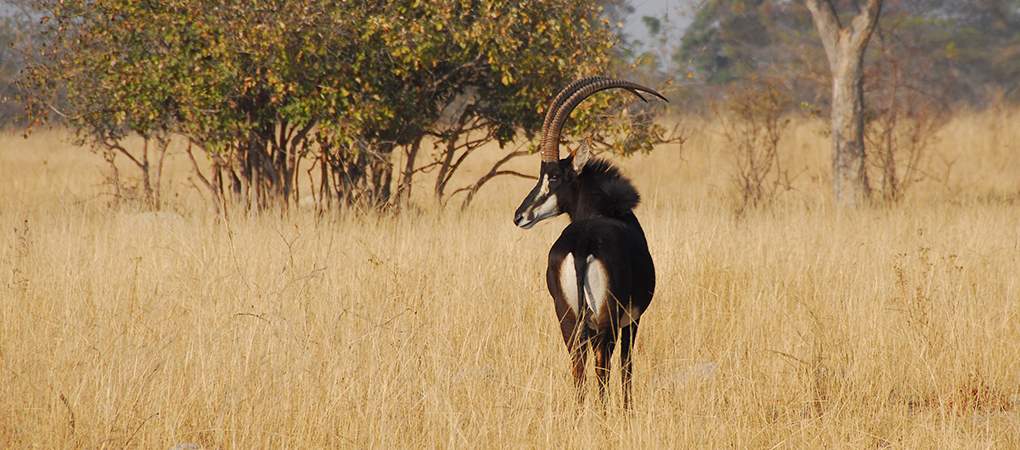
Most of today's game ranches are limited in size, ranging from a few to thousands of hectares, and fenced-off by game-proof fences. The game populations they sustain are largely isolated from other animals of the same species. This intensified, artificial system no longer offers game the opportunity to follow ancient migration routes between summer and winter veld, where suitable graze or browse is seasonally available. For this reason, game animals on most game farms do not have the same selection of graze and browse available to them as was formally the case in a larger, natural free-range system.
Animals are now forced to spend all year in generally the same area, whether the herbage is suitable or not. During the dry season the natural feeds are mostly dry, fibrous, tasteless and with a low nutritional value. Naturally the game rapidly lose condition during this time. Game animals are anatomically, physiologically and behaviourally adapted to subsist throughout the year on the vegetation available in their natural habitat, without supplementary feeding, provided their movements are not confined.
However, where they are artificially confined to one area throughout the year, as on practically every game ranch in the country, supplementary feeding becomes essential, to enable the animals to utilize the available herbage optimally, and still maintain condition. The owners of Safari Feeds realised that the crux of the problem was the form that this supplementary feeding should take on. It had to be convenient, economical, safe and acceptable to animals. This is where the challenge originated and the Safari Feeds range of products was developed.